
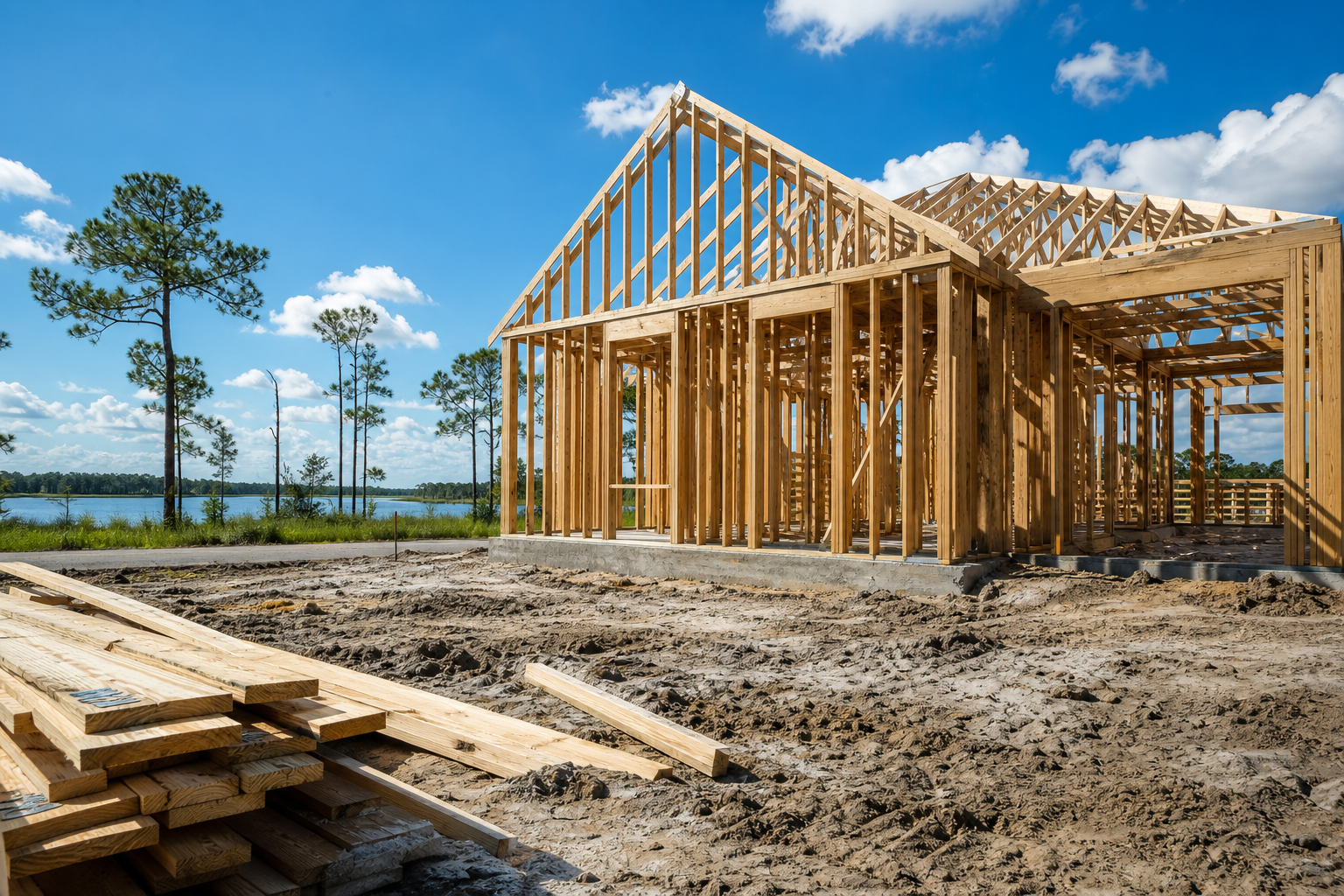
Building new in Jacksonville typically costs more upfront than buying an existing home once you factor in land, site work, permits, construction financing, and CDD assessments. The right answer depends on your lot, builder contract, target neighborhood, and how you model property taxes on the completed home.
Is it cheaper to buy or build in Jacksonville, FL?
Building new in Jacksonville is rarely cheaper than buying an existing home once you account for the full cost stack: land purchase, site preparation, permits, construction financing, upgrades, and carrying costs during the build. That said, the gap varies significantly by location, lot conditions, and the specific CDD and HOA obligations attached to each property. A true apples-to-apples comparison requires matching the same finished product on both sides of the ledger.
Key Takeaways
- The Jacksonville metro area median days on market reached 66 days in September 2026, according to the Federal Reserve Bank of St. Louis FRED series, signaling a slower market that gives buyers more negotiating room on both resale and new construction.
- The most recent Realtor.com data, from August 2026, shows a Jacksonville median list price of $380,000, down 4.8% year over year, meaning resale inventory is pricing more competitively than it was a year ago.
- A build-in-Jacksonville cost estimate that uses only a per-square-foot construction figure can omit land, site work, impact fees, construction-loan interest, and temporary housing, which together can add tens of thousands of dollars to the true total.
- CDD assessments in many Jacksonville-area new subdivisions are a separate annual charge from your property taxes and HOA dues, and they can materially change a home's carrying cost even when the purchase price looks competitive.
- Florida's homestead exemption and Save Our Homes assessment cap do not apply automatically in the first year of a new build; timing of completion, closing, and application deadlines all affect when you receive the full benefit.
What does it actually cost to build in Jacksonville vs. buy?
When a buyer asks me whether they should build in Jacksonville or buy an existing home, the first thing I do is slow them down. The question sounds simple. The math is not.
On the resale side, you have a known price, a home you can inspect, and a closing timeline measured in weeks. On the build side, you have a land cost, a construction contract, and a list of line items that most buyers don't see until they're already committed. Let me walk you through both.
The full cost of buying an existing home
The most recent Realtor.com Jacksonville market report, from August 2026, shows a median list price of $380,000, down 4.8% year over year. Active listings are also down 16.9% from a year ago, so inventory is tighter than it looks, even in a slower market.
For a resale buyer, the cost picture includes the purchase price, closing costs (title insurance, documentary stamp tax, recording fees, lender fees, and prepaid items), any immediate repairs flagged in the inspection, and the ongoing cost of maintaining a home that may have an aging roof, HVAC, or plumbing system. None of those deferred maintenance items show up in the list price.
What a resale home does give you: a known tax bill, an established HOA fee structure (if any), and no CDD debt-service obligation on a bond that was issued to build the subdivision's roads and utilities 10 years ago.
The full cost stack when you build in Jacksonville
This is where most build-versus-buy comparisons go wrong. They compare a finished resale home to a vacant lot plus an incomplete construction estimate. That comparison is biased toward building. Here's what a complete build cost actually includes:
- Land purchase: Lot prices in the Jacksonville area vary widely by location, size, flood zone, and whether utilities are already stubbed to the parcel. A lot that looks inexpensive on paper can require significant site work before a foundation goes in.
- Site preparation: Clearing, grading, fill, drainage, stormwater management, driveway, and erosion control. In low-lying or coastal areas of Jacksonville and St. Johns County, flood-zone requirements can add material cost here.
- Utility connections: Water, sewer, electric, and telecommunications connections, plus impact fees and connection charges assessed by the utility authority.
- Permits, plans, and inspections: Architectural and engineering drawings, plan review, building permits, and inspection fees.
- Base construction contract: The builder's base price, plus allowances (which are almost always spent over), upgrades, and change orders. Budget a contingency on top of the signed contract price.
- Construction financing: A construction loan carries interest during the build period, often six to twelve months or longer. That interest is a real cost. Add the cost of temporary housing if you can't stay in your current home during construction.
- Insurance and taxes during construction: Builder's risk insurance, property taxes on the lot, and the transition to a permanent homeowner's policy at closing.
- Owner-supplied finishes: Appliances, window treatments, landscaping, fencing, and anything else not included in the builder contract.
According to the Federal Reserve Bank of St. Louis FRED data, the Jacksonville metro area median days on market hit 66 days in September 2026, up from 59 days in June. That slower pace gives buyers more leverage on both resale pricing and builder incentives, but it doesn't change the underlying cost structure of a build.
Your specific numbers depend on your lot, your builder, and your target finishes. That's exactly the kind of analysis I walk my clients through before they commit to either path.
How do CDD fees and HOA dues change the comparison?
CDD and HOA costs are where the build-in-Jacksonville calculation most often surprises buyers. They're separate charges, they work differently, and they can add meaningful dollars to your annual carrying cost.
What is a CDD assessment and how does it work in Jacksonville-area communities?
A Community Development District (CDD) is a special-purpose local government authorized under Florida law to fund and maintain infrastructure, including roads, utilities, drainage, and amenities, within a defined area. Many of the master-planned communities in St. Johns County, including those in Nocatee, RiverTown, and surrounding areas, have one or more CDDs.
CDD assessments typically appear as a line item on your property-tax bill. They break into two components: a debt-service assessment (repaying the bonds that financed the original infrastructure) and an operations-and-maintenance assessment (ongoing upkeep). The debt-service portion can run for 20 to 30 years from the bond issuance date. A home in a newer section of a subdivision may carry a higher CDD debt-service assessment than one in an older section where the bonds are partially paid down.
Before you compare a new-construction price to a resale price, ask the builder or developer for the district name, the current adopted budget, the full assessment amount broken into debt-service and O&M, and the bond maturity schedule. The Florida Department of Economic Opportunity's CDD information is a useful starting point for understanding how districts are structured.
How do HOA fees compare between new and established communities?
HOA fees fund private community obligations: common-area maintenance, amenity operations, landscaping, and enforcement. They are community-specific and governed by each association's declaration, bylaws, and adopted budget. The Florida Department of Business and Professional Regulation oversees condominium and HOA regulation.
New subdivisions with resort-style amenity packages (pools, fitness centers, pickleball courts, dog parks) often carry higher HOA dues than older established neighborhoods with fewer shared amenities. That's not a rule, though. Some older communities have aging infrastructure that requires higher special assessments to maintain. You have to review the specific association's financials.
The key point: a community can have both a CDD and an HOA, one or the other, or neither. When you're comparing a new build to a resale home, add both charges to the annual carrying cost before you run the numbers.
| Cost Category | Resale Home | New Build |
|---|---|---|
| Purchase / Contract Price | Known at offer | Land + construction contract (subject to change orders) |
| Site Preparation | Generally included in price | Separate line item; varies by lot conditions |
| Construction Financing | Not applicable | Construction-loan interest during build period |
| CDD Assessment | Varies; older bonds may be lower or paid off | Typically at or near full bond amount in new sections |
| HOA Dues | Community-specific | Community-specific; review budget before contracting |
| Deferred Maintenance Risk | Present; inspect roof, HVAC, plumbing | Lower near-term, but builder warranty terms vary |
| Property Tax (Year 1) | Based on existing assessed value | Reset to completed-home value; homestead timing matters |
How does building new affect your Duval County property taxes?
Property taxes on a new build in Jacksonville don't work the way most buyers expect, and this is one of the most important differences in the build-versus-buy comparison.
When you buy a resale home, the prior owner's assessed value (and any Save Our Homes cap they accumulated) does not transfer to you. Your assessed value resets to market value in the year of sale. But if the prior owner had held the home for years, the tax bill you see in the listing may be lower than what you'll actually pay, because their assessed value was capped below market while yours will start fresh.
When you build new, the Duval County Property Appraiser assesses the completed improvement when the home is finished or substantially improved. The vacant lot's prior tax bill tells you almost nothing about what the completed home's first full-year tax bill will be. Budget for a tax estimate based on the completed taxable value, using the applicable Duval County, city, school-board, and other millage rates for the relevant tax year.
Florida's homestead exemption and the Save Our Homes assessment limitation can reduce your long-term tax exposure once established, but they don't apply automatically in the first year of a new build. Timing matters: completion date, closing date, and the January 1 assessment date all interact with the homestead application deadline. Confirm the specifics directly with the Duval County Property Appraiser and tax collector, not with the builder's sales team.
If you're moving from another Florida homestead, you may also have portability benefits to consider under Florida law. That's worth a conversation with a tax professional before you decide whether to build in Jacksonville or buy an existing home.
Every situation is different, and the only way to know what your tax picture actually looks like is to model it against the specific property, the specific millage rates, and your homestead status. That's a conversation I have with every client before we go under contract.
Frequently Asked Questions (FAQs)
Is it cheaper to buy an existing house or build one in Jacksonville in 2026?
Buying an existing home is generally less expensive upfront than building new in Jacksonville once you account for the full cost of land, site preparation, permits, construction financing, and carrying costs during the build period. The August 2026 Realtor.com data shows a Jacksonville median list price of 380,000 dollars, giving resale buyers a concrete benchmark to compare against a builder's total project cost. That said, new construction can offer lower near-term maintenance costs and modern energy efficiency, so the right answer depends on your specific lot, builder contract, and how you model ongoing costs like CDD fees and property taxes.
How much does a residential lot cost in Jacksonville, Florida?
Lot prices in the Jacksonville area vary significantly based on location, size, flood zone, utilities, and whether the parcel is in a developed subdivision or a raw land situation. A lot that appears inexpensive on the surface can require substantial site-work investment before a foundation can be poured, particularly in low-lying or coastal areas where drainage, fill, and flood-mitigation requirements add real cost. I always recommend getting a site-specific development estimate before comparing a lot price to a resale home price.
Do new-construction homes in Jacksonville have CDD fees?
Many new-construction communities in the Jacksonville area, particularly master-planned subdivisions in St. Johns County, do carry CDD assessments. These assessments fund the infrastructure bonds and ongoing maintenance for the district and typically appear as a line item on your annual property-tax bill. Before signing a new-construction contract, ask the builder for the specific district name, the full annual assessment broken into debt-service and operations-and-maintenance components, and the bond maturity schedule so you understand how long the obligation runs.
Does building a house reset my Duval County property taxes?
Yes. When a new home is completed or substantially improved, the Duval County Property Appraiser assesses the added improvement, which means the vacant lot's prior tax bill is not a reliable predictor of your first full-year tax obligation. You should model your expected tax bill using the completed home's taxable value and the current applicable millage rates, and confirm the homestead exemption application timeline directly with the Duval County Property Appraiser, since timing of completion and closing affects when you receive the full benefit.
What hidden costs should I budget for when building on a vacant lot in Jacksonville?
The costs that most often surprise buyers include construction-loan interest during the build period, temporary housing expenses, utility connection and impact fees, site-work items not covered in the builder's base contract (clearing, grading, fill, drainage), plan-review and permit fees, and owner-supplied finishes like appliances, window treatments, and landscaping. Jacksonville's coastal and low-lying areas can also add flood-zone compliance costs that don't show up in a builder's per-square-foot estimate. Getting a line-item breakdown from the builder and a site-specific development estimate from a contractor before you commit is the only way to avoid surprises.
The Bottom Line
The decision to build in Jacksonville or buy an existing home isn't just about purchase price. It's about the full cost stack: land, site work, construction financing, CDD and HOA obligations, property tax implications, and the time it takes to get into your home. Resale buyers get certainty. Build buyers get customization, but they take on more variables.
LET'S TALK ABOUT YOUR NEXT MOVE
Call/Text: (904) 599-2125
Email: greg@livinginjacksonvillefl.com
Website: https://www.livinginjacksonvillefl.com/
Want more real estate insight like this? Follow and Subscribe to the Living in Jacksonville FL Team on YouTube (@LIVINGINJACKSONVILLEFL) for neighborhood tours, market updates, and buyer tips you won't find anywhere else.
About Greg DeTullio, Broker/Owner, Living in Jacksonville FL Team
Greg DeTullio is a Florida-licensed Real Estate Broker and the founder of the Living in Jacksonville FL Team. With a decade of industry expertise, he has successfully managed over 200 closed transactions and earned five-star Google reviews. Greg specializes in Jacksonville relocation services and new construction within St. Johns County, proudly serving Nocatee, SilverLeaf, RiverTown, St. Johns, EverRange, Ponte Vedra Beach, and the surrounding Northeast Florida communities.
Living in Jacksonville FL Team | Phone: (904) 599-2125
Equal Housing Opportunity. Greg DeTullio, FL Real Estate Broker License #BK3332620, is a member of the Northeast Florida Association of Realtors (NEFAR). This article is general information only and does not constitute legal, tax, or financial advice. Confirm your specific costs, tax obligations, and transaction details with your attorney, tax advisor, lender, or closing officer.
Enjoy this blog post? Click here to subscribe for updates
Leave A Comment